Taula de Continguts
Understanding Post-Inflammatory Hyperpigmentation (PIH)
Post-inflammatory hyperpigmentation (PIH) manifests as dark spots or discolorations on the skin after an injury or inflammation, such as an acne breakout, has healed. These marks vary in color, from pink or red to brown or black, depending on skin tone and the depth of the pigmentation. PIH is a common concern and, although usually harmless, it can affect the uniformity of skin tone.
Why do dark spots appear after acne?
When the skin experiences inflammation, such as that caused by an acne lesion, skin cells (melanocytes) can produce an excess of melanin. This overproduction of pigment is deposited in the superficial or deeper layers of the skin, resulting in the appearance of spots. Unprotected sun exposure significantly aggravates this process, further darkening the marks.
It is important to distinguish PIH from atrophic or hypertrophic scars, which are changes in skin texture. PIH primarily affects skin color, while scars involve an alteration in tissue structure. A precise diagnosis by a medical professional is fundamental to determine the most appropriate treatment.
Prevention and Initial Management of PIH
Prevention is the first step in managing post-inflammatory hyperpigmentation. Avoiding picking at acne lesions reduces inflammation and, therefore, the likelihood of developing these spots. Daily sun protection is indispensable to prevent the darkening of existing marks and the appearance of new ones.
Daily care and sun protection
A gentle skincare routine, with non-comedogenic products and a broad-spectrum sunscreen with SPF 50, is crucial. Consistent use of sunscreen, even on cloudy days, helps to mitigate the activation of melanocytes by UV radiation. At Santé Clínica Estética, we recommend mineral sunscreens like Colorescience Sunforgettable Face Shield SPF 50 for effective protection.
According to dermatological studies, up to 65% of acne patients experience some degree of post-inflammatory hyperpigmentation, underscoring the importance of a preventive approach and early treatments.
Medical Treatment Options for PIH
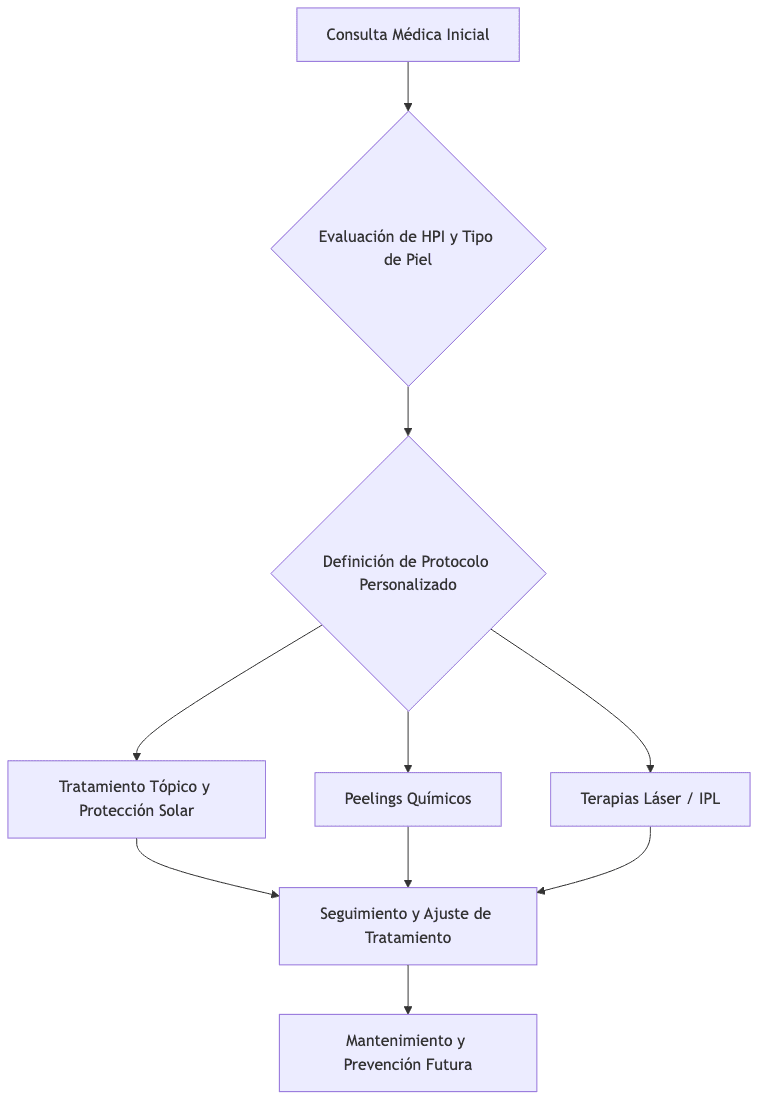
At Santé Clínica Estética, our board-certified medical team addresses PIH with a range of personalized treatments. The choice of protocol depends on skin type, pigmentation depth, and the extent of the spots. All treatments are performed under strict medical supervision to ensure safety and optimize results.
Topical treatments and chemical peels
Topical treatments include ingredients such as retinoids, vitamin C, azelaic acid, and kojic acid, which help to inhibit melanin production and accelerate cell renewal. Chemical peels, such as the Hollywood Peeling or photo-biodynamic peels, use acids to exfoliate the superficial layers of the skin. This promotes the elimination of pigmented cells and stimulates the regeneration of new, clearer skin.
| Treatment | Main Actives/Technology | Mechanism of Action | Price (EUR) |
|---|---|---|---|
| Hollywood Peeling | Activated carbon, Q-Switched Laser | Superficial exfoliation, pigment reduction | 150€ |
| Photo-biodynamic Peeling | Specific acids, LED light | Exfoliation, cell stimulation | 180€ |
| Facial Mesotherapy | Vitamins, hyaluronic acid, depigmenting agents | Hydration, nutrition, pigment reduction | 200€ |
| Microneedling | Microneedles, specific serums | Collagen stimulation, improved absorption | 150€ |
Laser therapies and intense pulsed light (IPL)
Laser technologies offer advanced solutions for PIH. The Q-Switched laser is effective for fragmenting pigment into smaller particles that the body eliminates. Intense pulsed light (IPL) targets pigmented areas, improving overall skin tone and reducing the visibility of spots.
At Santé, we use the Q-Switched laser to treat melasma and other pigmentations, as well as IPL for pigmentation spots. These treatments require a careful protocol and spaced sessions to ensure safety and efficacy. Individual results may vary.
Combined protocols for optimal results
Frequently, the most effective strategy for PIH involves a multimodal approach, combining different treatments. For example, a chemical peel can be initiated to prepare the skin, followed by laser sessions and a topical maintenance regimen. Dr. Sol Monsalve, our Medical Director, oversees the creation of these personalized plans.
How Santé Clinics approaches it
At Santé Clínica Estética, every patient with PIH begins with a comprehensive medical assessment. During this consultation, our board-certified doctors evaluate the depth and type of pigmentation, as well as the history of acne and skin phototype. This evaluation is crucial for designing a personalized protocol that addresses your specific needs safely and effectively.
Our approach focuses on naturalness and progressive improvement, using cutting-edge technologies such as the Q-Switched laser and IPL, complemented by peels and mesotherapy. We understand that each skin is unique and therefore, we adapt treatments to obtain optimal results, always seeking healthier, more even-toned skin.
We offer a free aesthetic consultation to discuss your concerns about PIH and explore the available treatment options. Our multilingual team, speaking Spanish, English, Portuguese, and Russian, is available to assist you at our clinic on Avenida Diagonal 384, Barcelona.
Key points
- Post-inflammatory hyperpigmentation (PIH) refers to dark spots that appear after skin inflammation, such as acne.
- Unprotected sun exposure is a key factor that aggravates PIH.
- Prevention includes not picking at acne and using daily sunscreen.
- Medical treatments include chemical peels, laser therapies (Q-Switched, IPL), and topical treatments.
- A combined and personalized protocol, supervised by doctors, offers the best results.
Frequently asked questions
How long does it take for PIH spots to disappear?
The time it takes for PIH spots to disappear varies considerably depending on the depth of the pigmentation, skin type, and treatment effectiveness. Some mild spots may fade in a few months with proper care, while deeper ones may require several months or even more than a year of consistent medical treatment. Patience and adherence to the protocol are essential.
Can I completely prevent PIH if I have acne?
While complete prevention cannot be guaranteed, significant steps can be taken to reduce the likelihood and severity of PIH. Avoiding squeezing or picking at acne lesions is fundamental, as this increases inflammation. Daily and rigorous use of a broad-spectrum sunscreen with SPF 50 is the most important preventive measure to avoid the darkening of post-inflammatory lesions.
Are laser treatments safe for all skin tones?
Laser therapies, such as Q-Switched and IPL, can be safe and effective for a wide range of skin tones, but their application must be performed by expert doctors. In darker skin types, there is a higher risk of hyperpigmentation or hypopigmentation if the appropriate laser settings are not used. Therefore, a detailed medical evaluation and precise adjustment of treatment parameters are indispensable at Santé Clínica Estética.
What is the difference between PIH and acne scars?
Post-inflammatory hyperpigmentation (PIH) refers to changes in skin color, manifesting as dark spots or discolorations. These spots do not alter skin texture. On the other hand, acne scars are permanent changes in skin texture, such as depressions (atrophic scars) or elevations (hypertrophic scars). Although they often coexist, the treatment for each condition is different, and a precise diagnosis is fundamental.
Is the treatment for dark spots painful?
Most treatments for post-inflammatory hyperpigmentation are well-tolerated. Chemical peels may cause a mild, transient stinging or burning sensation. Laser therapies may feel like small snaps or slight discomfort, which is generally tolerable. At Santé Clínica Estética, we always prioritize patient comfort and can apply topical anesthetic creams if necessary to minimize any discomfort during the procedure.