Taula de Continguts
- What are lentigines and freckles, and how do they form?
- How does laser treatment work for lentigines and freckles?
- Types of laser and their application
- Comparison: Q-Switched Laser vs. Intense Pulsed Light (IPL)
- The treatment process at Santé Clínica Estética
- Key points
- How Santé Clínica Estética approaches it
- Frequently asked questions
What are lentigines and freckles, and how do they form?
Solar lentigines, commonly known as "age spots" or "sunspots," are accumulations of melanin that appear on the skin due to chronic sun exposure. They are usually light to dark brown and oval-shaped, predominantly located in exposed areas such as the face, décolletage, and hands.
Freckles, on the other hand, are small pigmented spots that develop on the skin, especially in fair-skinned individuals. They are genetically determined and tend to darken with sun exposure. Unlike lentigines, freckles can appear from childhood.
Both are benign hyperpigmentations that, although not a health risk, can be an aesthetic concern for many people. The appearance of these spots reflects the interaction between our genetics and ultraviolet radiation.
How does laser treatment work for lentigines and freckles?
Laser treatment for lentigines and freckles is based on the principle of selective photothermolysis. This means that the laser emits light of a specific wavelength that is absorbed only by the melanin present in the spots.
The light energy converts into heat, fragmenting the pigment into tiny particles that the body naturally eliminates. This process is highly selective, allowing the spot to be treated without damaging the surrounding tissue.
At Santé Clínica Estética, we use technologies such as Q-Switched laser and Intense Pulsed Light (IPL). The Q-Switched laser is particularly effective for lentigines and freckles, as it emits very short, intense energy pulses that break down the pigment with great precision. IPL, meanwhile, is versatile and can treat a wider range of pigmentations, in addition to improving overall skin texture.
Types of laser and their application
The choice of laser type depends on the characteristics of the spot, the patient's skin type, and the medical assessment. Our specialists will determine the most suitable technology for each individual case.
Q-Switched Laser
The Q-Switched laser is advanced technology that emits ultrashort, high-energy light pulses. These pulses are selectively absorbed by melanin, fragmenting it into very small particles. It is a suitable option for well-defined solar lentigines and freckles.
The treatment is quick, and generally, few sessions are required. The skin may show temporary redness and a slight scab that disappears in a few days.
Intense Pulsed Light (IPL)
IPL is not a laser itself but a technology that emits a broader spectrum of light. It is very effective in treating lentigines, freckles, and other superficial pigmentations, as well as improving skin luminosity and homogeneity. It is a versatile option for photorejuvenation.
IPL allows for treatment of larger areas and is an excellent option for those seeking overall skin quality improvement in addition to spot treatment. The number of sessions may vary depending on the extent and depth of the spots.
Comparison: Q-Switched Laser vs. Intense Pulsed Light (IPL)
| Characteristic | Q-Switched Laser | Intense Pulsed Light (IPL) |
|---|---|---|
| Mechanism | Ultrashort, high-energy light pulses, selective for melanin. | Broad light spectrum, absorbed by melanin and hemoglobin. |
| Main indications | Solar lentigines, well-defined freckles, melasma. | Lentigines, freckles, superficial pigmentations, rosacea, photorejuvenation. |
| Precision | Very high, acts on specific pigment. | Good, but with less selectivity than Q-Switched laser. |
| Treatment area | Generally smaller areas and individual spots. | Larger areas, general skin improvement. |
| Number of sessions | Usually requires fewer sessions for specific spots. | May require more sessions, especially for photorejuvenation. |
| Sensation during treatment | Sensation of "rubber band snaps" or clicks. | Sensation of heat or small "whips." |
| Recovery | Redness, possible scab that disappears in days. | Mild redness, temporary darkening of spots. |
The treatment process at Santé Clínica Estética
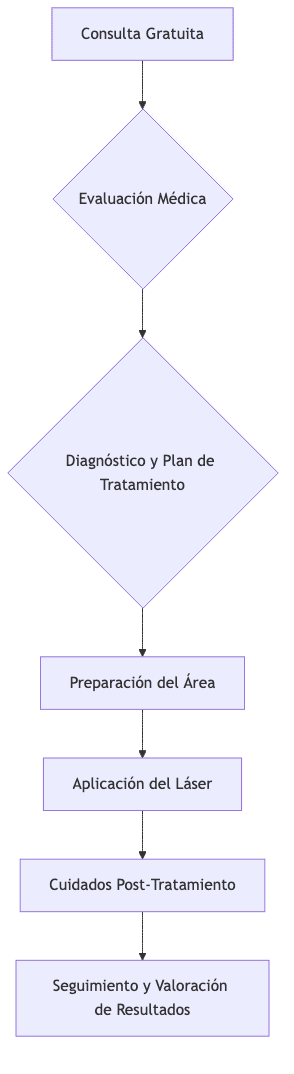
At Santé Clínica Estética, every treatment begins with a thorough medical consultation. During this first visit, our doctors evaluate the skin, identify the type of spots, and determine if laser treatment is the most suitable option.
Once the plan is established, sessions are scheduled. Before each session, the treatment area is cleaned, and protective eyewear may be applied. The procedure is generally well-tolerated, with many patients describing a sensation similar to small "rubber band snaps" on the skin.
After treatment, it is essential to follow our doctors' post-treatment instructions. This includes applying repairing creams and, crucially, strict sun protection. Treated skin will be more sensitive and require special care to ensure proper recovery and optimal results.
Key points
- Laser is an effective method for treating lentigines and freckles.
- The choice of laser type (Q-Switched or IPL) is made by a board-certified doctor after an assessment.
- The treatment works by fragmenting the melanin in the spots without damaging surrounding tissue.
- Post-treatment care is required, especially rigorous sun protection.
- Results vary depending on the type of spot and individual skin response.
How Santé Clínica Estética approaches it
At Santé Clínica Estética, our priority is your health and achieving natural, safe results. All treatments are performed or supervised by our team of board-certified doctors, who have extensive experience in managing various laser technologies.
We offer a free aesthetic consultation where our specialists will perform a comprehensive assessment of your spots and inform you about the most suitable personalized protocol for you. This individualized approach is crucial to ensure maximum effectiveness and safety.
Our team is prepared to assist you in Spanish, English, Portuguese, and Russian, ensuring clear and comfortable communication. We believe in transparency and in providing you with all the necessary information to make an informed decision about your well-being.
Frequently asked questions
Is laser treatment for spots painful?
Most patients experience minimal discomfort during treatment, described as a sensation of warmth or small pricks. In some cases, a topical anesthetic cream may be applied to increase comfort.
How many laser sessions are needed?
The number of sessions varies depending on the type, size, depth, and number of spots, as well as each individual's skin response. Generally, for lentigines and freckles, between 1 and 3 sessions are usually needed, spaced every 3-4 weeks.
How long do the results last?
Once treated, laser spots typically do not reappear in the same area. However, it is crucial to maintain adequate sun protection to prevent the formation of new spots in the future. The sun is the main trigger.
Are there side effects or contraindications?
Side effects are generally mild and temporary, such as redness, swelling, or the appearance of small scabs that disappear in a few days. Contraindications include pregnancy, lactation, certain skin diseases, or taking photosensitizing medications. All of this is evaluated during the initial consultation.
Can I sunbathe after treatment?
It is essential to avoid direct sun exposure in the treated area for at least 4-6 weeks after each session and to consistently use broad-spectrum sun protection (SPF 50+). Sun exposure can cause post-inflammatory hyperpigmentation and compromise results.