Taula de Continguts
What is fractional CO2 laser for stretch marks?
Fractional CO2 laser is a technology that uses micro-beams of light to create microscopic columns of heat in the skin. This controlled process stimulates cell regeneration and the production of new collagen and elastin. It is a medical option to improve the texture and color of stretch marks.
This treatment is indicated for both red (recent) and white (old) stretch marks. Efficacy may vary, generally being greater for more recent stretch marks. The surrounding skin remains intact, which speeds up the recovery process.
How does the treatment work and what can be expected?
Fractional CO2 laser acts on the dermis, the middle layer of the skin where stretch marks form. By generating thermal micro-injuries, the body activates its natural repair mechanisms.
This leads to the formation of new collagen and elastin fibers, improving skin elasticity and appearance. The goal is to smooth the texture and unify the tone of the stretch mark with the surrounding skin. Results are gradual and consolidate over months.
Number of sessions and timeline
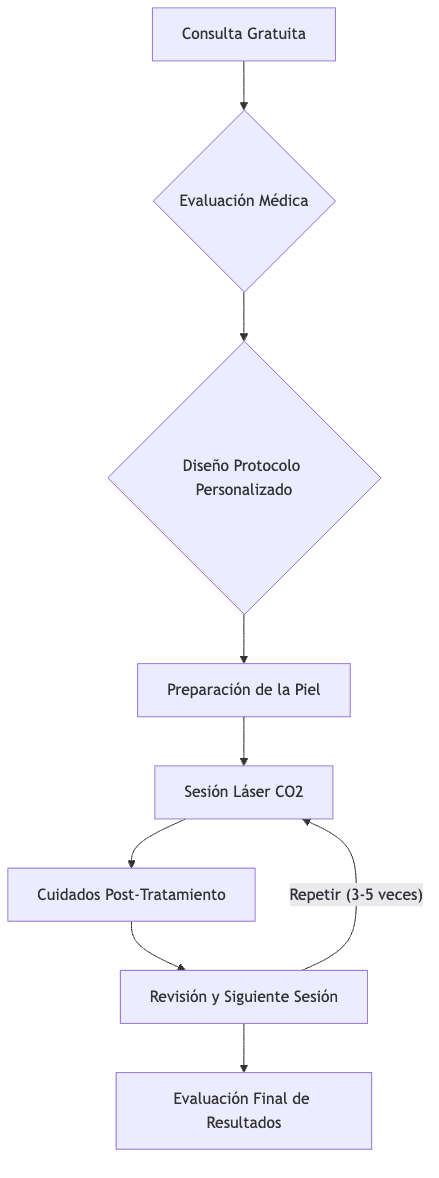
The number of sessions needed varies depending on the individual characteristics of the stretch marks and each patient's response. Generally, 3 to 5 sessions are recommended, spaced 4 to 6 weeks apart.
The first subtle changes can be observed after the second or third session. Continuous improvement extends for several months after the treatment cycle is completed, as collagen continues to regenerate.
| Aspect | Red Stretch Marks (recent) | White Stretch Marks (old) |
|---|---|---|
| Color | Reddish or purplish | Pearly white |
| Response to CO2 | Generally faster and more evident | Improved texture and pigmentation |
| Estimated Nº of sessions | 3-4 | 4-5 or more |
| Recovery time | Similar, 3-7 days per session | Similar, 3-7 days per session |
Sensations during and after treatment
During the session, it is common to feel a sensation of warmth or small pricks. To minimize discomfort, a topical anesthetic cream is applied before the procedure. The duration of each session depends on the size of the area to be treated, but usually ranges from 15 to 45 minutes.
After treatment, the skin may show redness and swelling, similar to a mild sunburn. These effects usually subside within 3 to 7 days. It is essential to follow post-treatment instructions, such as using repairing creams and sunscreen. The skin will be more sensitive to the sun, so it is recommended to perform the treatment in the autumn and winter months.
According to clinical studies, the improvement in the appearance of stretch marks with fractional CO2 laser can be 20% to 60% after several sessions, depending on individual response and the type of stretch mark.
What cannot be promised?
It is important to have realistic expectations. Fractional CO2 laser can significantly improve the appearance of stretch marks, but it does not eliminate them completely. The goal is to make them less visible and improve the quality of the affected skin.
Individual results may vary. A specific percentage of reduction or total elimination cannot be guaranteed. The skin's response to treatment depends on factors such as the age of the stretch marks, skin phototype, and each person's regenerative capacity.
Key points
- Fractional CO2 laser stimulates collagen and elastin regeneration.
- Improves the texture and color of red and white stretch marks.
- 3 to 5 sessions are required, spaced 4-6 weeks apart.
- Results are gradual and progressive.
- It is essential to protect the skin from the sun before and after treatment.
- Stretch marks are attenuated, not completely eliminated.
How Santé Clínica Estética approaches it
At Santé Clínica Estética, each fractional CO2 laser treatment for stretch marks begins with a thorough medical evaluation. Our board-certified doctors assess the type of stretch mark, the area to be treated, and the patient's clinical history. This initial consultation is free and essential to design a safe and effective treatment plan.
We develop a personalized protocol adapted to your specific needs and realistic expectations. You will be informed in detail about the procedure, post-treatment care, and expected results. Our medical team is available to answer any questions in Spanish, English, Portuguese, and Russian.
Frequently Asked Questions
Is CO2 laser treatment painful?
During the session, a slight discomfort may be felt, described as warmth or small pricks. We apply a topical anesthetic cream before treatment to ensure your comfort. Most patients tolerate the procedure well.
How long does recovery take?
Initial recovery usually lasts between 3 and 7 days. During this time, it is normal to experience redness, swelling, and a sensation similar to a sunburn. It is essential to follow post-treatment care instructions and avoid direct sun exposure.
When will I see the definitive results?
Results are gradual and progressive. Although subtle improvements can be observed after the first sessions, collagen remodeling is a slow process. Definitive results are fully appreciated between 3 and 6 months after the last session.
Are there any risks or side effects?
The most common side effects are redness, swelling, and temporary slight peeling of the skin. In rare cases, post-inflammatory hyperpigmentation (skin darkening) or hypopigmentation (lightening) may appear, especially if sun care is not followed. Our doctors minimize these risks with a strict protocol.
Can I combine CO2 laser with other treatments?
Yes, in some cases, CO2 laser can be combined with other treatments like mesotherapy or PRP to enhance results. This decision will always be made by your doctor after a personalized evaluation, ensuring the safety and effectiveness of the combined treatment.