Taula de Continguts
Barcode Wrinkles: CO₂ Laser or Filler?
When it comes to perioral wrinkles, popularly known as "barcode lines," choosing the right treatment is essential to achieve natural and effective results. At Santé Clínica Estética, we observe that while hyaluronic acid fillers have their place, fractional CO₂ laser often offers a more comprehensive solution for improving skin quality in this delicate area.
These fine vertical lines that appear around the lips are a common aesthetic concern. Their formation is due to a combination of factors: the natural loss of collagen and elastin, the repeated contraction of muscles around the mouth (when speaking, smoking, or gesturing), and chronic sun exposure. Over time, these lines become more evident, affecting the skin's texture in this area.
Fractional CO₂ Laser: The Solution for Skin Quality
Fractional CO₂ laser is an advanced technology that directly addresses skin quality, making it an effective option for barcode wrinkles. This treatment creates micro-columns of thermal energy in the skin, leaving surrounding areas intact. This controlled process stimulates the body's natural ability to produce new collagen and elastin, improving skin texture and elasticity.
Unlike fillers, which add volume, fractional CO₂ laser works on the surface and deeper layers of the skin to renew it. The result is smoother, firmer skin with a significant reduction in fine lines and wrinkles.
How does CO₂ laser work?
Fractional CO₂ laser emits light pulses that are absorbed by water in skin cells. This causes controlled vaporization of tissue at microscopic points, leaving areas of intact skin around them. These untreated areas facilitate faster and safer recovery.
The thermal energy also contracts existing collagen fibers and activates fibroblasts to synthesize new collagen and elastin. This dermal remodeling process continues for weeks and months after treatment, offering progressive results.
Hyaluronic Acid Fillers: When are they an option?
Hyaluronic acid fillers are an excellent solution for restoring lost volume or for filling deeper static wrinkles. In the case of barcode wrinkles, they can be useful if there is significant volume loss in the upper lip or if the wrinkles are very pronounced and require additional structural support.
However, for fine lines and overall improvement of skin texture, fillers may not be the most suitable option. Excessive filling in this area can lead to an unnatural result or a feeling of heaviness around the mouth. The decision between laser and filler, or a combination of both, should always be made by a specialist doctor after a detailed evaluation.
CO₂ Laser vs. Filler: A Comparison
To help you better understand the differences and applications of each treatment, we have prepared a comparative table:
| Characteristic | Fractional CO₂ Laser | Hyaluronic Acid Fillers |
|---|---|---|
| Mechanism of action | Stimulates collagen and elastin production, improves skin texture. | Adds volume and directly fills wrinkles. |
| Main indication | Fine wrinkles, improvement of skin quality and texture, mild laxity. | Deep wrinkles, volume loss, lip contour. |
| Results | Progressive, long-term improvement in skin quality, natural appearance. | Immediate, volume restoration, smoothing of specific wrinkles. |
| Duration of effect | Long-lasting, as it stimulates the skin's own regeneration. | Temporary (6-18 months), requires maintenance. |
| Recovery | Requires downtime (redness, peeling). | Minimal or none (possible mild swelling or bruising). |
| Risk of "exaggerated" appearance | Low, as it works with the skin's natural regeneration. | Higher if applied excessively or improperly. |
Key points
- Barcode wrinkles are perioral lines caused by aging, gesturing, and sun exposure.
- Fractional CO₂ laser is effective for these wrinkles by improving skin quality and stimulating collagen.
- Hyaluronic acid fillers are more suitable for restoring volume or deep wrinkles, but not for superficial texture.
- The choice of treatment depends on individual medical evaluation and wrinkle type.
The CO₂ Laser Treatment Process at Santé Clinics
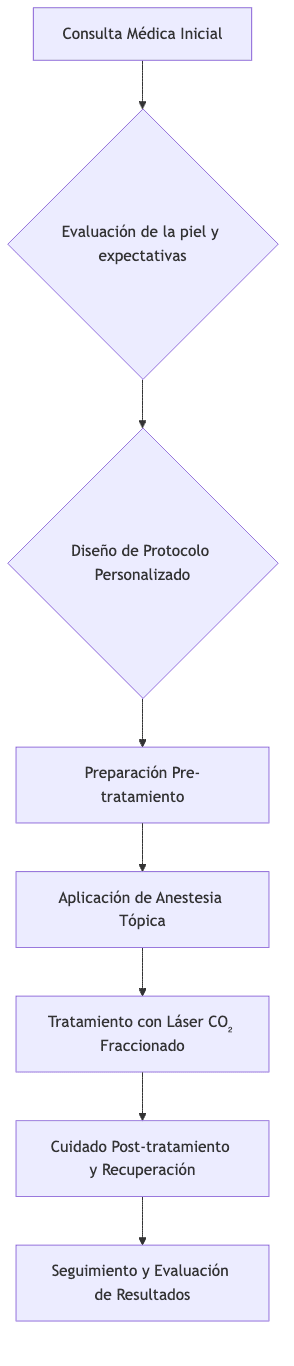
At Santé Clinics, we understand that every skin is unique. Therefore, fractional CO₂ laser treatment for barcode wrinkles begins with a comprehensive medical consultation. Our team of board-certified doctors will evaluate your skin type, wrinkle depth, and expectations to design a personalized protocol.
Before treatment
You will be provided with detailed instructions to prepare your skin, which may include avoiding direct sun exposure and the use of certain topical products. It is crucial to inform your doctor about any existing medications or medical conditions.
During treatment
A topical anesthetic cream is applied to minimize any discomfort. The procedure usually lasts between 30 and 60 minutes, depending on the area to be treated. The doctor will use the fractional CO₂ laser device with settings adapted to your specific needs.
After treatment and recovery
It is normal to experience redness, swelling, and a sensation similar to a sunburn during the first few days. The skin may peel slightly. You will be given clear guidelines for post-treatment care, including the use of repairing moisturizing creams and strict sun protection. Total recovery time varies, but generally the skin recovers in 5-7 days for mild to medium treatments, and up to two weeks for more intense treatments. Progressive results are seen as the skin produces new collagen, with noticeable improvement in 2-3 months.
Collagen remodeling induced by fractional CO₂ laser can continue for up to six months after treatment, progressively improving skin firmness and elasticity.
Price Table (per session)
| Treatment | Price (EUR) |
|---|---|
| Fractional CO₂ laser perioral (mild) | 300 |
| Fractional CO₂ laser perioral (medium) | 400 |
| Fractional CO₂ laser perioral (strong) | 600 |
| Fractional CO₂ laser perioral (very strong) | 1200 |
How Santé Clinics Approaches It
At Santé Clínica Estética, our focus is on naturalness and medical safety. Every treatment, including fractional CO₂ laser, is performed by board-certified doctors who ensure the highest standards of quality and care. We conduct a detailed initial medical assessment to ensure that the treatment is right for you, and we design a personalized protocol for your specific needs.
We offer a free aesthetic consultation to discuss your concerns and explain the available treatment options. Our team speaks Spanish, English, Portuguese, and Russian, ensuring clear and comfortable communication. In cases of severe skin pathologies that exceed the scope of aesthetic medicine, our doctors will guide you to the appropriate dermatological specialist.
Frequently Asked Questions
How many CO₂ laser sessions are needed?
The number of sessions varies depending on the depth of the wrinkles and the individual skin response. Generally, 1 to 3 sessions are recommended, spaced every 4-6 weeks. Our medical team will provide you with a specific treatment plan during your consultation.
Is CO₂ laser treatment painful?
Thanks to the application of topical anesthetic cream before the procedure, most patients experience only slight discomfort or a warm sensation. The level of pain is subjective, but it is effectively managed for your comfort.
Can I combine CO₂ laser with other treatments?
Yes, in many cases, fractional CO₂ laser can be combined with other treatments such as mesotherapy or skin boosters to optimize results in skin quality and luminosity. Any combination of treatments will be carefully planned by your doctor to ensure safety and efficacy.
What are the contraindications for CO₂ laser?
Contraindications include pregnancy, lactation, active infections in the treatment area, a history of keloid scarring, or recent use of some photosensitizing medications. A complete medical evaluation is essential to determine if you are a suitable candidate for the treatment.