Taula de Continguts
Understanding Post-Acne Marks
The marks left by acne on the skin can be a cause for concern, but it is crucial to distinguish them to apply the appropriate treatment. Generally, they are classified into two broad categories: dyschromias (color changes) and scars (texture changes). Understanding the difference is the first step towards more even and healthy skin.
Dyschromias include red spots (post-inflammatory erythema) and dark spots (post-inflammatory hyperpigmentation). Scars, on the other hand, involve a permanent alteration of the skin's structure. These can be atrophic (indented) or hypertrophic/keloid (raised).
Red Spots (Post-Inflammatory Erythema)
Red spots, medically known as post-inflammatory erythema (PIE), are the result of dilated blood vessels in the area where an acne lesion occurred. They are common in fair skin and appear as pink or reddish areas that do not change color when pressed.
They usually appear immediately after an acne breakout resolves. Although they can take weeks or even months to disappear on their own, their presence indicates that the skin is in the process of healing. Sun exposure can worsen them, making sun protection essential.
Dark Spots (Post-Inflammatory Hyperpigmentation)
Post-inflammatory hyperpigmentation (PIH) manifests as brown, gray, or even black spots on the skin. They are more common in darker skin phototypes and are caused by excessive melanin production during the inflammatory process of acne. These spots can persist for months or years if left untreated.
Like redness, PIH is exacerbated by ultraviolet radiation, so rigorous sun protection is fundamental. Its appearance indicates that the inflammatory process has left a pigmentary trace. Identifying the type of spot is essential for selecting the most effective treatment protocol.
Acne Scars: When Skin Texture Changes
Acne scars are permanent alterations in the skin's texture, resulting from abnormal tissue repair after a deep lesion. Unlike spots, scars do not completely disappear over time without intervention, as they involve a loss or excess of dermal tissue.
There are several types of atrophic scars, which are characterized by being indented in the skin. Icepick scars are deep and narrow, similar to a puncture. Boxcar scars are wider, with defined edges and a flat bottom. Rolling scars have a softer, wavy appearance, without such marked edges.
On the other hand, hypertrophic scars and keloids are raised, resulting from excessive collagen production during healing. These are less common in facial acne but can occur on the trunk. Medical evaluation is indispensable to determine the type and treatment strategy.
Comparative Table: Spots vs. Scars
| Characteristic | Red Spots (PIE) | Dark Spots (PIH) | Atrophic Scars | Hypertrophic/Keloid Scars |
|---|---|---|---|---|
| Appearance | Pink/Red, flat | Brown/Gray/Black, flat | Indented, texture changes | Raised, texture changes |
| Cause | Post-inflammatory vasodilation | Post-inflammatory melanin overproduction | Loss of dermal tissue after deep lesion | Excessive collagen production |
| Spontaneous disappearance | Yes, but can take months | Yes, but can take years | No | No |
| Impact on texture | No | No | Yes | Yes |
| Treatment | Vascular laser, IPL, photobiodynamic | Q-Switched laser, peels, depigmenting agents | Fractional CO2 laser, Erbium, microneedling, subcision | CO2 laser |
Key Points
- Red spots (PIE) are color changes due to vascular inflammation.
- Dark spots (PIH) are color changes due to excess melanin.
- Atrophic scars are indented, and hypertrophic/keloid scars are raised, both with texture alteration.
- Sun protection is fundamental to prevent the worsening of all marks.
- Accurate medical evaluation is the first step towards an effective treatment plan.
How Santé Clinics Addresses It
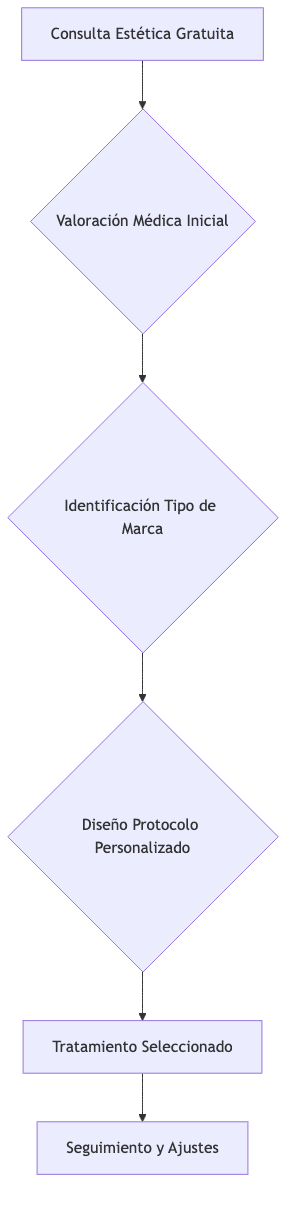
At Santé Clínica Estética, we understand that every skin is unique and requires an individualized approach. Our team of board-certified medical doctors performs a comprehensive assessment of your skin to determine the type of acne marks present and your skin phototype. This initial evaluation allows us to design a personalized treatment protocol, always with the goal of achieving natural and harmonious results.
For post-acne redness, we may consider treatments such as vascular laser or Intense Pulsed Light (IPL), which act on dilated blood vessels. For dark spots, Q-Switched laser and chemical peels are effective options that help even out skin tone. In the case of scars, we have advanced technologies such as fractional CO2 laser or Erbium laser, as well as microneedling or subcision, which stimulate collagen production and improve skin texture.
Safety and efficacy are our priorities. All our procedures are performed by experienced doctors, ensuring compliance with the highest quality standards. We invite you to a free aesthetic consultation at our clinic at Avenida Diagonal 384, in Barcelona, where our team can assist you in Spanish, English, Portuguese, or Russian and answer all your questions.
Frequently Asked Questions
Can acne scars disappear on their own?
Acne scars, being permanent alterations in skin texture, do not usually disappear completely without medical intervention. Red or pigmentary spots can fade over time, but scars require specific treatments to improve their appearance. Our medical team can evaluate your case and suggest the most appropriate protocol.
How long do acne spots take to disappear?
The time it takes for acne spots to disappear varies significantly depending on the type and depth of the mark, as well as the skin phototype and sun exposure. Red spots (PIE) can take weeks to several months to resolve spontaneously. Dark spots (PIH) can persist for months or even years. Medical treatments can significantly accelerate this process.
What is better for acne marks: laser or peels?
The choice between laser and peels, or a combination of both, depends on the specific type of acne mark and the individual characteristics of your skin. Lasers like Q-Switched or IPL are excellent for treating pigmentary spots and redness, while fractional CO2 laser or Erbium are very effective for improving the texture of scars. Chemical peels are versatile and can treat both pigmentation and improve the skin surface. A medical assessment is essential to determine the most suitable option for you.
Is the treatment for acne marks painful?
The perception of pain is subjective and varies depending on the treatment. At Santé Clínica Estética, we strive to minimize any discomfort during procedures. Many treatments, such as IPL or some superficial peels, are well tolerated. For more intense procedures like fractional CO2 laser, topical anesthesia is applied, and cooling systems are used to ensure your comfort. Our doctors will inform you in detail about what to expect during and after each session.