
Table of Contents
- What is intimate dryness in menopause and why does it occur?
- Hyaluronic Acid for Intimate Hydration
- Radiofrequency for Intimate Regeneration
- Who are candidates for these treatments?
- Treatment Comparison: Hyaluronic Acid vs. Radiofrequency
- How Santé Clínica Estética addresses it
- Key points
- Frequently asked questions
What is intimate dryness in menopause and why does it occur?
Intimate dryness is a frequent condition affecting many women during menopause. It primarily occurs due to a decrease in estrogen levels, hormones essential for maintaining the hydration, elasticity, and health of vaginal tissues. This hormonal deficiency leads to thinning and reduced lubrication of the vaginal mucosa.
Symptoms can include irritation, itching, burning sensation, and pain during sexual intercourse. It is a medical concern that affects a woman's comfort and general well-being. At Santé Clínica Estética, we understand these discomforts and offer effective solutions.
Hyaluronic Acid for Intimate Hydration
Hyaluronic acid is a substance naturally present in the body, known for its ability to retain large amounts of water. When injected into the intimate area, it acts as a powerful moisturizer.
This treatment improves tissue turgor and elasticity, relieving dryness and irritation. Results vary individually, but many patients experience a noticeable improvement in comfort. It is a safe and minimally invasive procedure.
How does hyaluronic acid treatment work?
The procedure consists of infiltrating small amounts of hyaluronic acid specifically designed for the intimate area. It is performed in the clinic and is usually well-tolerated, lasting approximately 30 minutes. The board-certified doctors at Santé Clínica Estética perform this treatment with precision.
- Initial Medical Consultation
- Evaluation and Planning
- Preparation of the Intimate Area
- Application of Topical Anesthesia (if necessary)
- Precise Infiltration of Hyaluronic Acid
- Gentle Massage for Uniform Distribution
- Post-Treatment Instructions
- Follow-up and Maintenance
The substance integrates into the tissues, attracting and retaining water to restore natural hydration. The aim is a progressive improvement of the vaginal mucosa and a reduction of atrophy symptoms. The initial medical assessment is crucial to determine the suitability of the treatment.
Radiofrequency for Intimate Regeneration
Radiofrequency is another effective tool in the management of intimate dryness and vaginal atrophy. It uses controlled thermal energy to stimulate the production of collagen and elastin in the tissues.
This neocollagenesis process improves the elasticity, tone, and vascularization of the area. It contributes to greater natural lubrication and recovery of firmness. It is a non-ablative and comfortable treatment for the patient.
How does INDIBA radiofrequency act in the intimate area?
At Santé, we use INDIBA technology, which applies radiofrequency waves to generate internal heat. This heat stimulates cellular activity and tissue regeneration without damaging the skin's surface. The treatment is performed with a specific applicator for the intimate area.
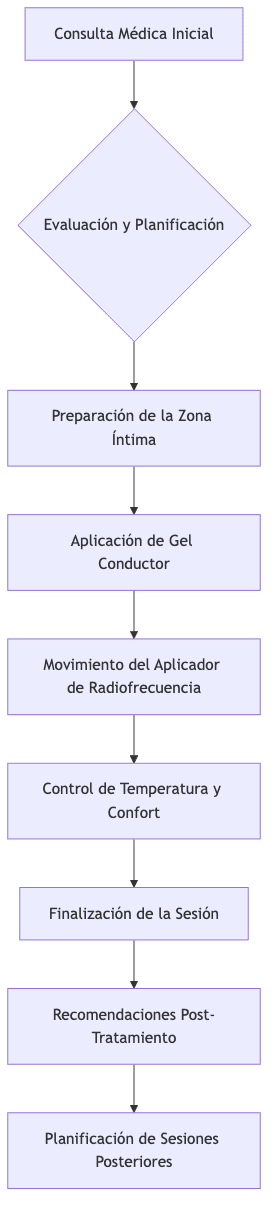
Sessions are painless and last approximately 20-30 minutes. Several sessions are usually recommended to optimize results, spaced over time. Protocols are supervised by our medical team.
Who are candidates for these treatments?
These treatments are indicated for women in menopause who experience vaginal dryness, itching, irritation, or dyspareunia (pain during sexual intercourse). Women with postpartum vaginal atrophy or atrophy due to other causes may also benefit. A medical evaluation is essential.
A prior consultation with our medical team is fundamental to evaluate your clinical history and determine the most suitable treatment. The goal is to achieve results that improve functionality and comfort, always with a personalized approach. Results vary according to each patient's individual response.
Treatment Comparison: Hyaluronic Acid vs. Radiofrequency
Both treatments offer solutions for intimate dryness, but they act differently and can be complementary.
| Characteristic | Hyaluronic Acid | INDIBA Radiofrequency |
|---|---|---|
| Main mechanism | Direct hydration and volumization | Stimulation of collagen and elastin |
| Main effect | Relief of dryness, increased turgor | Progressive improvement of elasticity, tone, and lubrication |
| Duration of effect | Variable, usually requires annual maintenance | Cumulative results, periodic maintenance |
| Number of sessions | According to medical assessment | According to medical assessment |
| Price per session | According to medical assessment | According to medical assessment |
How Santé Clínica Estética addresses it
At Santé Clínica Estética, every treatment for the intimate area begins with a thorough medical consultation. Our medical team evaluates your individual case. Expectations are discussed, and a personalized treatment plan is designed, which may include hyaluronic acid, radiofrequency, or a combination of both.
We prioritize patient safety and comfort at all times. All procedures are performed by board-certified doctors, ensuring maximum professionalism. We offer services in Spanish, English, Portuguese, and Russian to adapt to the needs of our international patients.
Intimate dryness is a common concern in menopause, affecting a significant number of women.
Key points
- Intimate dryness in menopause is treatable with hyaluronic acid and radiofrequency.
- Hyaluronic acid directly hydrates and restores turgor.
- INDIBA radiofrequency stimulates collagen and elasticity for long-term improvement.
- Both treatments are safe, minimally invasive, and performed by medical specialists.
- An initial medical consultation is essential for a personalized treatment plan.
Frequently asked questions
Are these treatments painful?
Both treatments are generally well-tolerated. For hyaluronic acid infiltrations, topical anesthesia can be applied to minimize any discomfort. INDIBA radiofrequency is a procedure that generates a pleasant warm sensation and is not usually painful.
How long do results take to appear?
With hyaluronic acid, improvement in hydration is perceived relatively soon, often after the first session. In the case of radiofrequency, results are progressive and become more evident after several sessions, as collagen and elastin regenerate. Results vary individually.
How long do the effects of the treatments last?
The duration of hyaluronic acid effects varies, but an annual maintenance session is generally recommended. For radiofrequency, results are cumulative, and periodic maintenance sessions are suggested to prolong their benefits. Our medical team will offer you a suitable follow-up plan for your case.
Are there any contraindications?
Yes, there are some contraindications, such as active infections in the area to be treated, pregnancy or lactation, and certain autoimmune diseases or oncological treatments. Therefore, the initial medical consultation is fundamental to ensure that the treatment is safe and appropriate for you.
Can hyaluronic acid and radiofrequency be combined?
Yes, in fact, combining both treatments can offer more complete and synergistic results. Hyaluronic acid provides immediate hydration and volume, while radiofrequency works on deep and long-term tissue regeneration. Our medical team will assess whether this combination is the most indicated for your case.