
Taula de Continguts
- Dehydrated skin or dry skin: they are not the same
- What happens to the skin barrier when the air is dry
- A dry climate all year round: summer, winter and indoors
- Signs that your skin is dehydrated
- The daily routine: cleanse without harshness, hydrate and protect
- In-clinic treatments that add hydration
- How we work at Santé Madrid
- Frequently asked questions
To stop Madrid's dry climate from dehydrating your skin, the key is to protect the skin barrier: gentle cleansing, a cream that combines ingredients that draw in water with others that hold it in, daily sunscreen and a little more humidity at home. If your skin still feels tight or looks dull, there are in-clinic treatments that add hydration, always after an assessment. In this guide we explain how dehydrated skin differs from dry skin, what happens to the barrier when the air holds little moisture, how to organise your daily routine and when it makes sense to have a doctor take a look.
Key points
- In an aesthetic consultation we usually distinguish dry skin, a skin type with few lipids, from dehydration, a state of water shortage that can appear in any skin type, including oily skin.
- Transepidermal water loss measures how much water escapes through the outermost layer of the skin; low ambient humidity and cold are among the factors associated with dry skin.
- A dry continental climate can affect the skin in any season, not only in winter.
- The foundation is your routine: gentle cleansing, humectants with emollients or occlusives, and daily sun protection.
- Skin boosters, Baby Glow, HydraFacial and cosmeceuticals are supporting options that the medical team assesses case by case. Results vary from skin to skin.
Dehydrated skin or dry skin: they are not the same
In an aesthetic consultation it is common to distinguish between two situations that look alike but are not the same. Dry skin is a skin type: it produces few lipids, often feels rough and tends to stay with you for years. Dehydrated skin, on the other hand, describes a state: the outermost layer is short of water, and that can happen in dry, combination or oily skin. This distinction is practical, not a formal medical diagnosis, but it helps you choose products well.
The difference matters because it changes what you need. Oily skin that feels tight after washing, with shine on the T-zone and fine lines that show up by the end of the day, may be dehydrated even though it produces sebum. If you respond to that tightness with harsher cleansers or less cream for fear of breakouts, the problem may get worse.
Skin hydration depends mainly on the integrity of the stratum corneum, the outermost layer, and on its lipids, such as ceramides. A review of the factors that influence skin hydration notes that ultraviolet exposure, ageing and low temperatures can alter the skin's ceramide composition and increase water loss (Camilion and colleagues, 2022). That is why we talk about the barrier, and not just about water.
What happens to the skin barrier when the air is dry
The skin loses water to the environment all the time. That loss has a name: transepidermal water loss, or TEWL. A systematic review defines it as an objective measure of skin integrity that quantifies the water lost through the stratum corneum (Green and colleagues, 2022).
A review of moisturisers published in a dermatology journal lists low ambient temperature and low humidity among the factors that contribute to dry skin, alongside exposure to chemicals, ageing, stress and conditions such as atopic dermatitis (Sethi and colleagues, 2016). A study of healthy women who spent several hours in a room with very dry air observed that the skin reacts within a short time and that this response varies with the prior state of their barrier (Ishikawa and colleagues, 2026).
It is worth being honest about the evidence. The same systematic review on TEWL found contradictory results on the effect of season and climate, with no clear consensus. In other words, dry air is a factor that can play a part, but not the only one: your skin type, your age, your routine and your habits weigh as much or more.
A dry climate all year round: summer, winter and indoors
The capital's climate is continental and tends to be dry: sunny summers, cold winters and, in general, little moisture in the air. That means dehydration is not only a winter problem. Each season can affect the skin in a different way, and it is worth adapting your routine rather than using the same cream all year.
In summer, strong sun and dry heat can leave the skin tight and dull, especially if you spend time outdoors without protection or move back and forth between air conditioning and the street. The Camilion review reminds us that ultraviolet exposure is one of the factors that can alter the skin's ceramides.
In winter, the cold outside and heated indoor spaces can add to the dryness. It is not the central topic of this guide, but if you spend many hours in closed indoor spaces, you will notice your skin asks for more care.
In spring and autumn, sharp temperature changes between morning and afternoon can also be felt by sensitive skin. The answer, in any season, is the same: protect the barrier consistently and adjust the texture of your products to how your skin behaves.
Signs that your skin is dehydrated
Dehydration is not always visible to the naked eye. It is often felt before it shows in the mirror. These are the signs most often described in consultation, and how to tell them apart from skin that is dry by nature:
| Sign | What it may indicate | What usually helps |
|---|---|---|
| Tightness after washing your face | A cleanser that is too harsh or a weakened barrier | A gentle cleanser and cream straight afterwards, while the skin is still damp |
| Fine lines that show more by the end of the day | Lack of water in the surface layer | Humectants such as glycerin or hyaluronic acid, sealed with a cream |
| Dull look and make-up that cracks | A dehydrated surface with uneven texture | A consistent hydration routine and very gentle exfoliation, only if the skin tolerates it |
| Shine on the T-zone with tight cheeks | Dehydrated oily or combination skin | Light, non-comedogenic textures, without skipping hydration |
| Flaking, itching or cracks | More intense dryness or an underlying condition | Richer creams or ointments and a medical assessment if it does not improve |
The American Academy of Dermatology points out that dry skin can flake, itch, crack and even bleed (AAD, tips for dry skin). If you reach that point, we are no longer talking only about surface dehydration.
The daily routine: cleanse without harshness, hydrate and protect
Most of the work is done at home. These are the principles the AAD recommends for dry skin, and they also apply to dehydrated skin:
- Gentle cleansing. Short showers or baths in warm water, a gentle cleanser without a thick lather, and patting the skin dry without rubbing.
- Cream at the right moment. Apply a fragrance-free moisturiser straight after washing, while the skin is still damp, and reapply whenever it feels dry.
- Texture and ingredients. The AAD notes that creams and ointments add more moisture than lotions, and lists ingredients such as glycerin, hyaluronic acid, dimethicone, shea butter or petrolatum.
- Fragrance-free products. Avoid products with alcohol, fragrance or retinoids if your skin is dry, and mention it in your consultation if you use one on medical advice.
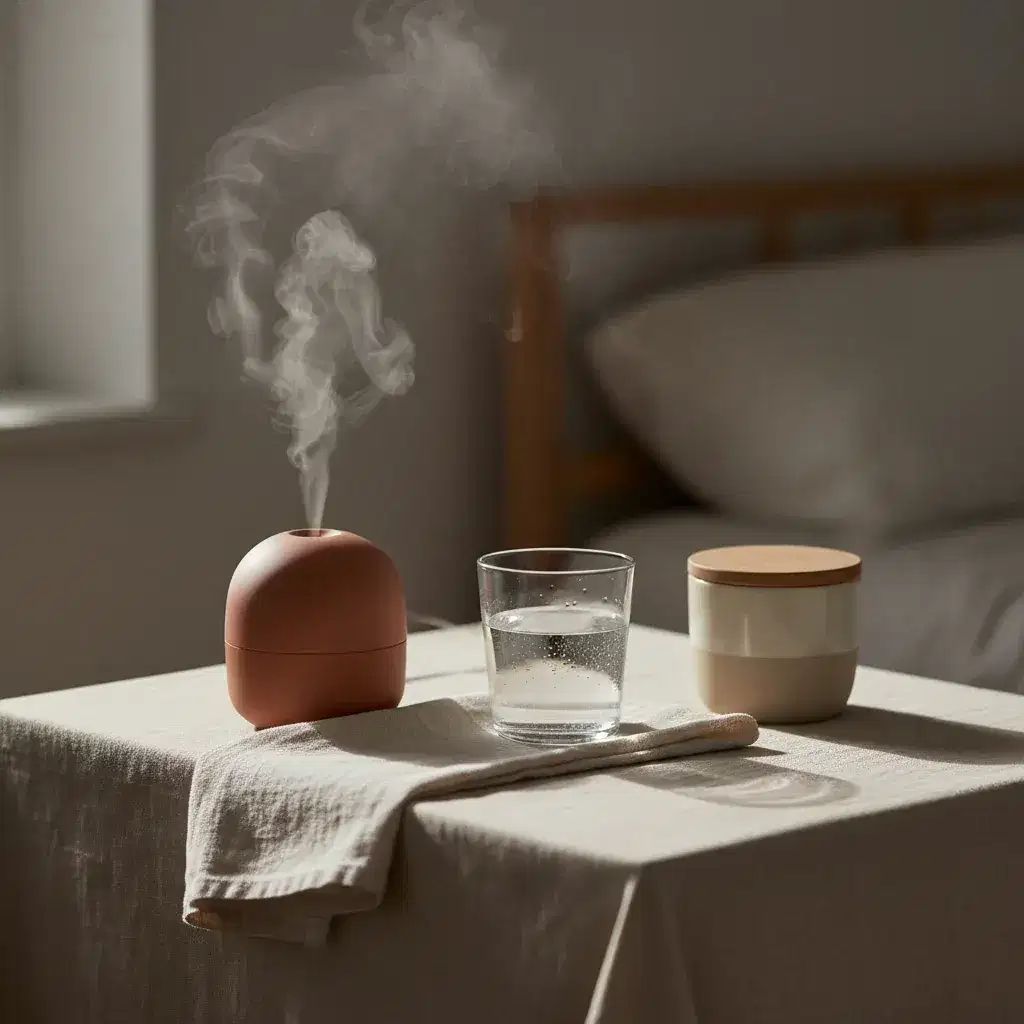
- Humidifier. Raise the humidity in your bedroom with a humidifier, cleaning it regularly to prevent mould.
There is a reason to combine ingredients. The Sethi review explains that humectants draw in water but can increase water loss when used alone, which is why they are usually combined with occlusives, which form a layer that slows it down. In practice: a serum with hyaluronic acid or glycerin works better if you then apply a cream that seals it in.
The last step in the morning is sunscreen. The AAD recommends a broad-spectrum, water-resistant sunscreen with SPF 30 or higher (AAD, how to select a sunscreen). With the city's sunshine, it is worth using it all year, not just in summer.
In-clinic treatments that add hydration
When the routine is well set up and the skin still feels tight or looks dull, the medical team may suggest supporting treatments. None of them replaces daily care, and the choice depends on the assessment of your skin.
Skin boosters. These are micro-injections of hyaluronic acid into the dermis, sometimes combined with other active ingredients. A systematic review of injectable hyaluronic acid described improvements in the hydration, radiance, texture and elasticity of facial skin, with a good safety profile, although its authors call for larger trials (Ghatge and Ghatge, 2023). You can read more about the skin booster treatment.
Baby Glow. This is another injectable treatment focused on skin quality. Its treatment page describes it as non-crosslinked hyaluronic acid with vitamins and amino acids, without adding volume or changing your features.
HydraFacial. According to the manufacturer, it cleanses, exfoliates, extracts and hydrates the skin in one treatment (HydraFacial, treatments). It can be an occasional complement, but it does not replace your daily routine.
Cosmeceuticals. We work with SkinCeuticals, ZO, ASM and Biotricología, and the team can guide you on which products suit your skin. Treatments are carried out by the medical team after an assessment, and results vary from skin to skin.
How we work at Santé Madrid
Santé Clinics Madrid is at C. de Amador de los Ríos, 1, Chamberí, 28010 Madrid, close to Almagro and Salamanca. We are open Monday to Friday from 9:00 to 21:00 and on Saturdays from 10:00 to 15:00; the clinic is closed on Sundays.
We start with a free aesthetic consultation with a Beauty Coach, in which we review your skin, your current routine, the products you use and what you notice in each season. Often the first change happens at home: a gentler cleanser, a better-chosen cream or the sunscreen that was missing.
If there is a medical condition, a medication or questions about an injectable treatment, the Santé Madrid medical team assesses it in a medical consultation, which costs €50. With that information we suggest, if it makes sense, a plan that may combine your routine, cosmeceuticals and treatments such as skin boosters, Baby Glow or HydraFacial. If we see something that needs a dermatologist's attention, we will tell you.
We make no promises about results. Results vary from skin to skin, and we prefer to explain calmly what you can expect before you start.
Frequently asked questions
How do I know whether my skin is dry or dehydrated?
Dry skin tends to feel rough all the time and produces few lipids. Dehydrated skin feels tight and looks dull, with fine lines that come and go, and it can even be oily. We review it with you in the aesthetic consultation.
Can oily skin be dehydrated?
Yes. Oily skin can be shiny and feel tight at the same time. In that case it is better to hydrate with light textures rather than dropping cream altogether.
Is drinking more water enough to hydrate the skin?
Skin hydration depends mainly on the state of its barrier and its lipids. Drinking enough water is part of a healthy lifestyle, but it does not replace a good routine.
Which ingredients should I look for in a cream for a dry climate?
The AAD lists, among others, glycerin, hyaluronic acid, dimethicone, shea butter and petrolatum. What helps is combining a humectant with a cream that seals the hydration in.
Do I need sunscreen in winter?
Yes. The AAD recommends a broad-spectrum sunscreen with SPF 30 or higher, and in a sunny city it is worth using it all year round.
What is the difference between a skin booster and Baby Glow?
Both are injectable treatments with hyaluronic acid focused on skin quality. The medical team decides which one suits you after assessing your skin, and results vary from skin to skin.
When should I see a doctor about dry skin?
If the dryness does not improve with your routine, if there is itching, cracking or inflammation, or if any product irritates you. There may be an underlying condition that should be assessed.
If your skin feels tight, dull or uncomfortable at any time of year, a consultation at Santé Madrid will help you understand what it needs and build a routine that makes sense for you. We will explain calmly what options you have and what you can expect.