
Taula de Continguts
- What the Observ 520x is and what it is used for in a consultation
- The Observ 520x light modes, according to Sylton
- Why it matters to photograph under the same conditions every time
- How the analysis fits with a HydraFacial plan
- Comparing images over time: what they can show and what they cannot
- How we work at Santé Madrid
- Frequently asked questions
Skin analysis with the Observ 520x is used to photograph and document how your skin looks before you start a HydraFacial plan, and to do so again, under the same conditions, over time. It is not a promise of results: it is an orderly way to record the starting point and to follow how the skin evolves with comparable images. In this guide we explain what the Observ 520x is according to its manufacturer, Sylton, which light modes it describes, why it matters to repeat the same conditions every time and how all of this fits with HydraFacial at Santé Madrid.
Key points
- The Observ 520x is a facial imaging system by Sylton designed to document the skin during a consultation with different light modes.
- Sylton describes 10 light modes, from a daylight image to polarised and ultraviolet light modes.
- Images are only comparable if they are taken under similar conditions: the same light, the same position and skin prepared in the same way.
- Comparing images helps you follow how the skin evolves, but it does not ensure any change: results vary from one skin to another.
- The images support the team's assessment; they do not replace a medical consultation.
What the Observ 520x is and what it is used for in a consultation
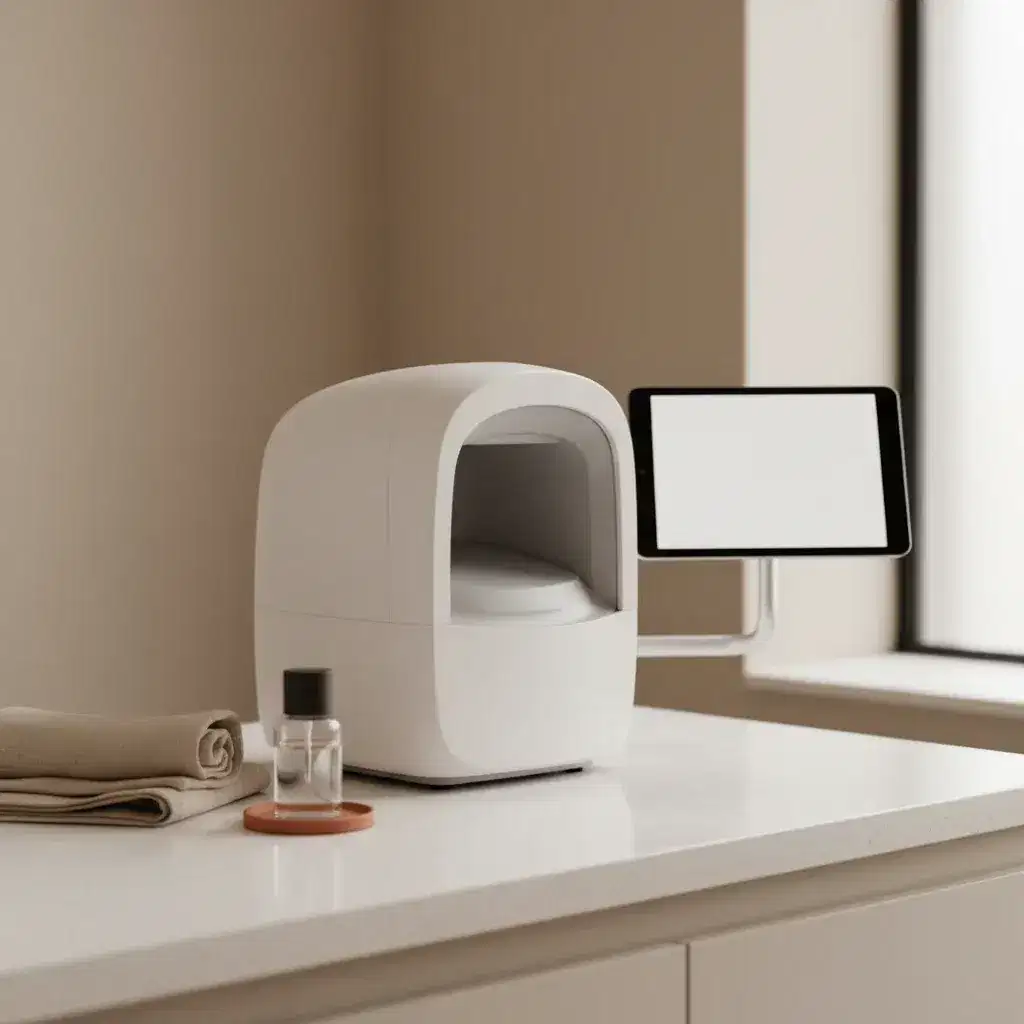
The Observ 520x is a facial imaging system made by Sylton. According to its manufacturer, it is designed for the consultation room: it lets the practitioner photograph the face under different types of lighting, store those images in each person's record and use them to explain what they observe in the skin (Sylton, Observ 520x). The manufacturer also states that a capture takes about 10 seconds on average and that the device is controlled from an iPad.
Devices of this kind belong to what the scientific literature calls computer-assisted full facial imaging systems. A review published in 2024 explains that they are used in dermatology and aesthetic medicine to assess, non-invasively, aspects such as pigmentation, redness, texture or signs of ageing, and also to follow up treatments, and it lists OBSERV among the commercial systems available (Zhang et al., 2024).
It is worth being clear about its role. The images do not make a diagnosis on their own: they are a visual aid for the person assessing your skin and for you, as you can see in more detail what is discussed in the consultation. Interpreting them remains the team's job.
The Observ 520x light modes, according to Sylton
The most distinctive feature of the Observ 520x is that it photographs the same face under different kinds of lighting. Sylton describes 10 light modes on its website and groups them into illumination modes and visualisation modes. This table summarises how the manufacturer describes each one (Sylton, Observ 520x); it is not a list of diagnoses, but of what each image aims to highlight.
| Mode | What it highlights according to Sylton |
|---|---|
| Daylight | A baseline image of the skin as it looks under normal lighting |
| Surface Texture | Surface details, such as fine lines and skin smoothness |
| Pigmentation | Variations in skin tone, areas of uneven pigmentation and of sun exposure |
| Vascularity | Areas of redness, as an aid to identify sensitivity or reactions |
| Parallel Polarised | Light reflection on the surface, which accentuates texture and natural glow |
| Cross Polarised | Reduces shine to show deeper layers and the skin barrier more clearly |
| True UV | Sub-surface pigmentation, bacterial activity and variations in skin thickness |
| Simulated Wood's | Simulates the Wood's lamp effect to show oil balance and dry areas |
| 360 Light (light from 360 degrees) | Lets you change the direction of the light to show small irregularities in relief and texture |
| 360 Grey (greyscale, 360 degrees) | Greyscale lighting that removes colour to focus on form and contours |
Sylton also describes functions to assess facial symmetry and expressions. Which modes are used in each consultation depends on what needs to be documented: not all of them are always needed.
Why it matters to photograph under the same conditions every time
A phone photo taken in the bathroom and another taken in the clinic months later cannot be compared rigorously: the light, the distance, the angle and even the expression change. That is why dermatology insists on standardised photography. An article in the British Journal of Dermatology notes that reliable, standardised photos are key for care, documentation and monitoring the skin over time, and explains that cross-polarised light removes surface reflections and helps show structures beneath it, such as blood vessels, while non-polarised light highlights surface texture (Oh et al., 2021). The same article points out that capturing redness accurately is harder in darker skin.
The 2024 review on facial imaging systems makes a similar point: results can vary considerably if the ambient lighting or the angle of the face changes from one visit to the next, and loose hair or facial expression can influence the analysis (Zhang et al., 2024).
To reduce those differences, Sylton describes a face positioning system designed to repeat the same position between sessions, a chinrest for photographing the face at 0°, 40° and 90°, and accessories such as a shade that reduces ambient light in the ultraviolet and Wood's modes, or a headband and cape to limit reflections (Sylton, Observ 520x).
How the analysis fits with a HydraFacial plan
HydraFacial is a hydradermabrasion treatment that combines cleansing, extraction and hydration; at Santé Madrid we work with the Signature, Deluxe and Platinum protocols, with boosters, and the team chooses the protocol after assessing your skin. If you want the details of each step and each protocol, we explain them in our guide to HydraFacial in Madrid. Here we focus on a different question: what documenting the skin adds before and during a plan.
Before the first session, a set of baseline images can support the conversation about what concerns you: whether your skin looks dull, your pores more visible, or you notice dry areas or redness. Seeing it on screen, under different lights, can help you put into words what you feel and help the team explain what they observe.
Later, if the plan includes several sessions or maintenance, repeating the images under similar conditions lets you compare with more than memory. This makes it possible to consider calmly whether to keep the protocol, adjust it or consider another option. The device does not make the decision: the team makes it with you, with the images as one more part of the assessment.
Comparing images over time: what they can show and what they cannot
"Measuring the before and after" does not mean promising a specific after. It means having a comparable record of the starting point and of how your skin evolves. That comparison may show changes, few changes or changes that have nothing to do with the treatment.
Skin is not static. In Madrid, the strong summer sun, the dry air and winter heating can influence how it looks, and so can rest, the hormonal cycle, a new routine or an occasional breakout. If you compare an image from July with one from January, part of the difference may be due to the season. That is why it is useful to note the context of each capture and not to draw conclusions from a single comparison.
The images also have technical limits. The 2024 review explains that some modes can overlap, for example between pigmentation and blood vessels, that manual review of the images is sometimes still necessary and that, in ultraviolet fluorescence, residues of cosmetics or sunscreen may be visible (Zhang et al., 2024). That is why it is usually recommended that the skin be clean at the time of the capture.
How we work at Santé Madrid
Santé Clinics Madrid is at C. de Amador de los Ríos, 1, Chamberí, 28010 Madrid, and we are open Monday to Friday from 9:00 to 21:00 and on Saturdays from 10:00 to 15:00; the clinic is closed on Sundays. At the clinic we have Sylton's Observ 520x and HydraFacial with the Signature, Deluxe and Platinum protocols.
The process starts with a free aesthetic consultation with a Beauty Coach, in which we talk about your skin, your routine and what you would like to improve. If there is a medical condition, medication or a question that calls for it, it is assessed in a medical consultation, which costs €50. When the team considers it useful, the Observ 520x can support that assessment, and we decide with you which images make sense in your case.
With that information, the Santé Madrid medical team proposes the HydraFacial protocol that suits your skin and, where appropriate, when it makes sense to review how it is evolving. We do not promise results: results vary from one skin to another, and we prefer to explain what you can expect in your case before you start.
Frequently asked questions
What is the Observ 520x?
It is a facial imaging system by Sylton that photographs the face with different light modes to document the skin during a consultation. The images support the team's assessment, but they do not make a diagnosis on their own.
Do the Observ 520x images show the result I will get with HydraFacial?
No. The images record how your skin looks at a specific moment. They are used to document the starting point and follow how it evolves, not to predict a result, which varies from one skin to another.
Why do the images have to be repeated under the same conditions?
Because changes in light, angle, distance or expression alter the image. If the conditions are similar, the comparison between one visit and the next is more reliable.
Do I have to come without make-up?
It is usually recommended that the skin be clean at the time of the capture, because residues of cosmetics or sunscreen can be visible in some modes. The team will tell you how to prepare it in your case.
Does image analysis replace a medical consultation?
No. It is a visual aid. If you are worried about a spot, a mole that has changed or a skin condition, the right step is a medical consultation and, where appropriate, a dermatologist's assessment.
How often should the images be repeated?
It depends on your plan and your goals. The team will suggest when it makes sense to review how your skin is evolving, also taking into account factors such as the time of year.
What happens to my photographs?
Your images are personal data. Before the capture you can ask how they are stored and what they are used for, and clear up any questions with the team.
If you are thinking of starting a HydraFacial plan and want to do so with a clear record of how your skin looks, a consultation at Santé Madrid is a good starting point. We will calmly explain what we can document and what you can expect.