Taula de Continguts
- What ClearSkin is and how it works on active acne
- What the evidence says, and what it does not
- ClearSkin and the dermatologist: a complement, not a substitute
- How many sessions and how often
- What you feel during and after the session
- Caring for acne-prone skin in Madrid
- Who ClearSkin is not for
- How we work at Santé Madrid
- Frequently asked questions
ClearSkin is a Harmony XL Pro laser designed to treat the inflamed spots of active acne in the clinic, without the treatment itself involving any pills. It can be an option for mild or moderate acne and a complement to medical treatment, but it does not replace a dermatologist when acne is moderate or severe. In this guide we explain how it works, what the evidence says, how many sessions are usually planned, what it feels like, how to care for your skin in Madrid and who it is not for.
Key points
- ClearSkin is a 1540 nm Er:Glass laser, non-ablative, with suction and cooling built into the handpiece, according to its manufacturer, Alma Lasers.
- Its energy heats the dermis, where the sebaceous glands sit, and the suction and cooling of the handpiece can reduce the sensation of pain.
- The evidence is promising but limited: small studies, with results that vary from skin to skin.
- Moderate or severe acne needs assessment by a dermatologist; ClearSkin can accompany that treatment, not replace it.
- Pregnancy, skin with a wound or infection, photosensitivity and extensive nodular or cystic acne are reasons to wait or choose another path.
What ClearSkin is and how it works on active acne
ClearSkin is one of the handpieces of the Alma Lasers Harmony XL Pro platform. On the official Harmony XL Pro product page, the manufacturer describes it as a 1540 nm Er:Glass non-ablative laser, indicated for active acne and acne scars, whose energy induces tissue coagulation and dermal remodelling. The same page notes that the handpiece includes suction and cooling.
Non-ablative means it does not remove the surface layer of the skin: the energy passes through it and acts at depth. According to a review of lasers for acne published in the Journal of Clinical and Aesthetic Dermatology, mid-infrared lasers, including 1540 nm lasers, heat skin structures non-selectively, including the sebaceous glands, and biopsies taken after treatment have shown those glands becoming smaller. The water in the dermis is the predominant absorber of this light, and melanin absorbs it to a lesser extent.
Suction and cooling have a specific role. In a study published in Lasers in Medical Science with the Alma 1540 nm laser, the authors explain that the glands affected by acne lie deep in the skin, and that handling the skin with suction and contact cooling may improve the interaction between laser and skin, reduce the sensation of pain and increase safety.
What the evidence says, and what it does not
It is worth reading the studies calmly. The Lasers in Medical Science study included 12 people with mild to moderate acne. Each breakout was first treated with the suction and cooling tip, followed by several laser pulses, in sessions every 2 weeks. Two dermatologists assessed the photos independently and all patients showed moderate to significant improvement. The only adverse effect observed was temporary redness.
There are important caveats. It is a small study with no comparison group. In addition, the average improvement score was lower at 3 months than at one month after finishing, which indicates that the effect can fade over time and that acne, as a chronic condition, usually needs follow-up.
The Journal of Clinical and Aesthetic Dermatology review reflects the same caution: although most studies with mid-infrared lasers report improvement, some found no difference compared with the control group or did not analyse whether it was significant, and in some, patients continued with their usual medication. That is why we speak of an option with a scientific basis, not a solution that is certain for everyone. Results vary from skin to skin.
ClearSkin and the dermatologist: a complement, not a substitute
The title of this guide says "without pills" and it is worth being precise about what that means. ClearSkin is a treatment done in the clinic that, in itself, does not require taking any medicine. That may interest someone with mild or moderate acne who is looking for an in-clinic option, or someone already following a treatment who wants to add something more. It does not mean that medication is a mistake or that you should stop what your doctor has prescribed.
The review cited above concludes that lasers have shown efficacy as a primary or complementary treatment for acne in certain clinical scenarios. The key lies in the scenario. When acne is moderate or severe, leaves marks or does not respond, the right step is a consultation with a dermatologist, and if your case requires it we will point you to that specialist. The table gives an approximate summary of the role of each.
| Situation | Role of ClearSkin | What is recommended |
|---|---|---|
| Mild or moderate acne with inflamed spots | Can be an in-clinic option after a medical assessment | A plan with the medical team and care at home |
| Moderate or severe acne, with nodules or cysts | At most, a complement to medical treatment | A consultation with a dermatologist before any laser |
| You are already following a treatment prescribed by your dermatologist | Can be considered as support if your dermatologist agrees | Tell us everything you take and apply |
| Acne that does not improve or gets worse again | It is not the first step | Review by a dermatologist |
| Established marks and scars | A different goal, with a different plan | A specific scar assessment |
If scars are your main concern, we cover them in another guide on laser for acne scars.
How many sessions and how often
There is no fixed number. In the study with the Alma 1540 nm laser, patients received 4 to 6 sessions at intervals of 2 weeks. That schedule is a reference for how it has been studied, not a preset protocol at our clinic. The number of sessions and the interval are proposed by the doctor based on how many inflamed spots you have, in which areas, how your skin responds and whether you are following another treatment at the same time.
Because improvement can fade over the months, the plan usually includes a review once the initial sessions are finished. From there the doctor assesses whether home care is enough, whether an additional session later on would help or whether the case needs a dermatologist's opinion.
The manufacturer, on the Harmony XL Pro page, presents this handpiece as suitable for treatments all year round. This is a manufacturer's statement: the indication and timing are decided by the doctor after the assessment, and daily sun protection is still necessary. You can see how we approach the other options on our laser for acne page.
What you feel during and after the session
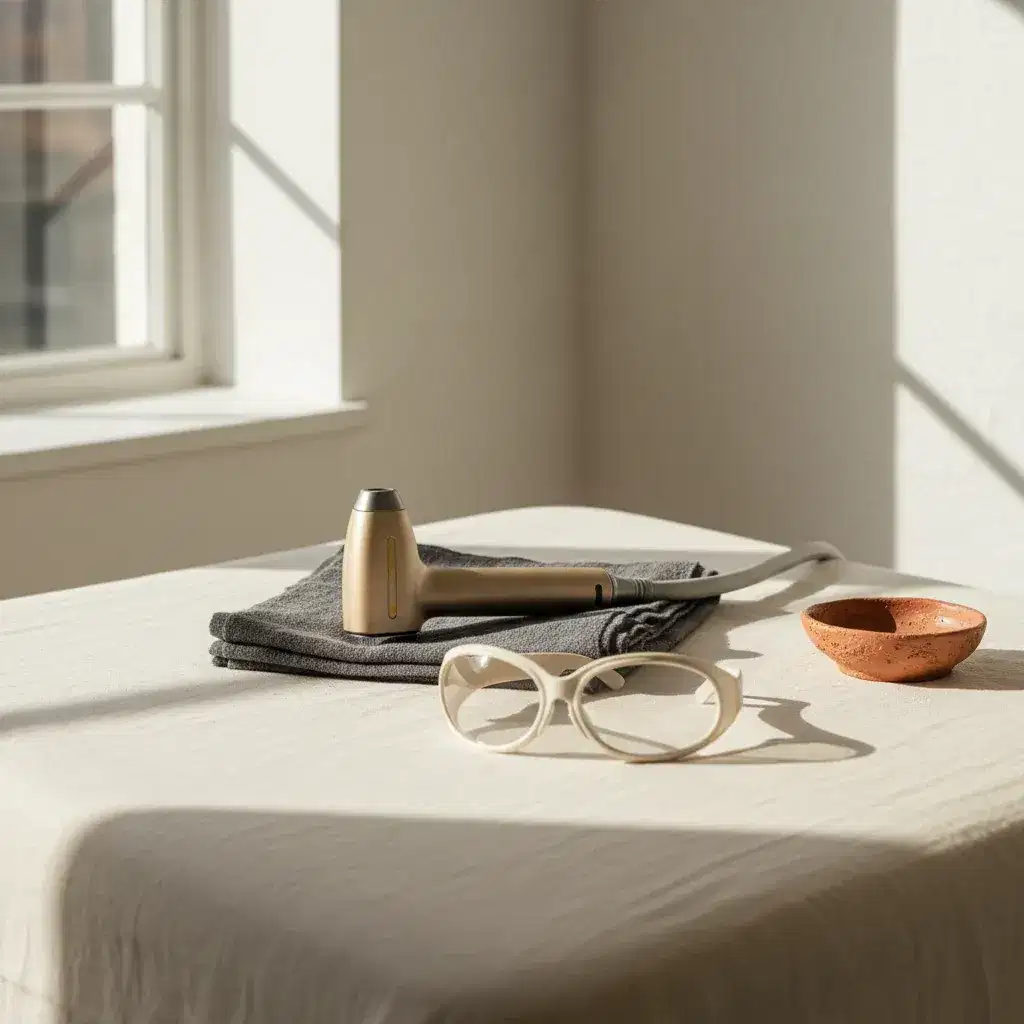
Before starting, the skin is cleansed and the eyes are protected. Then the doctor places the tip of the handpiece on each inflamed area: first you will feel the suction, which gently pulls the skin, and the cold of the contact, and then the laser pulses, which usually feel like heat or brief pricks. The intensity depends on the area and your sensitivity, and the doctor adjusts it during the session. The Lasers in Medical Science study notes that the combination of suction and cooling may reduce the sensation of pain.
Afterwards it is common to see reddened skin. The review of lasers for acne describes mild to moderate pain during the session with these lasers, as well as temporary redness and swelling. The same review notes that, in some studies with Asian patients, post-inflammatory hyperpigmentation occasionally appeared. That is why parameters are chosen with caution according to skin type and reviewed at each visit. If something does not progress as we explained, write to us.
Caring for acne-prone skin in Madrid
The laser is only one part. Acne-prone skin usually responds better when home care does not irritate it. Madrid's continental climate, with dry air, sunny summers and cold winters, can influence how it behaves. In winter, heating can dry out the surface, and tight skin is sometimes treated with harsher cleansers, which can worsen irritation. Urban pollution is another factor that can affect the skin throughout the day.
A simple routine usually helps between sessions:
- Gentle cleansing morning and night, without rubbing or exfoliating hard.
- A light moisturiser that does not clog pores.
- Broad-spectrum sunscreen every morning, in winter too.
- Do not touch or squeeze spots, before or after the session.
- Check with the doctor before adding acids, exfoliants or other actives, especially in the days around the session.
If you follow a routine from your dermatologist, do not change it on your own: tell us what you use and we will build it into the plan. Specific cosmetics are recommended by the team according to your skin type.
Who ClearSkin is not for
ClearSkin is not for everyone or for any moment. Nor is everything that looks like acne actually acne: some facial breakouts have another origin and need a different diagnosis, and rosacea with spots, for example, is assessed differently. That is why the first visit is used to confirm what you have before talking about sessions. There are situations where the right thing is to wait, see a dermatologist first or choose another path.
If during the assessment we see that your case needs dermatological treatment, we will tell you clearly. It is better to start with the right step than to add sessions that will not solve the underlying problem.
How we work at Santé Madrid
Our clinic is at C. de Amador de los Ríos, 1, Chamberí, 28010 Madrid. We work with the Harmony XL Pro platform and its AFT, ClearLift, Q-Switched, iPixel Er:YAG, ClearSkin and Nd:YAG vascular handpieces. This is the usual path when you come in for active acne:
- First consultation. You can start with a free aesthetic assessment with a Beauty Coach or with a €50 medical consultation. We go over how long you have had acne, what you have tried, what you take and what you apply.
- Medical assessment. The Santé Madrid medical team examines the type of lesions, how widespread they are and whether there is anything a dermatologist should see first.
- Plan. If ClearSkin is indicated, the doctor decides on the areas, how many sessions and at what interval, and whether to combine it with other care or treatments.
- Session. Cleansing, eye protection and application to the inflamed areas, adjusting the parameters to what the doctor observes.
- Follow-up. Before each session we review how your skin has responded and, at the end, we assess the next steps.
The treatment is carried out by the medical team after an assessment. Results vary from skin to skin, and our goal is a realistic and safe plan for you, not a promise of results. If your acne needs a different approach, we will point you to the right specialist.
Frequently asked questions
Does ClearSkin replace treatment from a dermatologist?
No. It can be an in-clinic option for mild or moderate acne and a complement to medical treatment, but moderate or severe acne needs a dermatologist's assessment.
What does it mean that it is a treatment without pills?
That the laser session itself does not require taking any medicine. It does not mean you should stop what your doctor has prescribed: if you are following a treatment, tell us.
Does it hurt?
It usually feels like heat or brief pricks, along with the suction and cooling of the handpiece. The intensity depends on the area and your sensitivity, and the doctor adjusts it during the session.
How many sessions will I need?
There is no fixed number. In the cited study, 4 to 6 sessions were given every 2 weeks; at our clinic there is no preset protocol, and the number and interval are set by the doctor after the assessment.
Can I go back to my routine after the session?
It is common to see reddened skin for a while. It is best to use gentle products and sunscreen, and to check with the doctor before adding acids or exfoliants.
Does it work for acne scars?
The manufacturer also indicates it for scars, but they are a different goal and are assessed with their own plan. In this guide we focus on active acne.
Can I have it if I have darker skin?
Melanin absorbs this light to a lesser extent, but in some skin a temporary mark can appear after the inflammation. The doctor assesses your skin type and adjusts the parameters with caution.
ClearSkin makes it possible to treat active acne in the clinic without the session involving any medication, with a scientific basis that is promising but still limited. It works best as part of an honest plan: knowing what type of acne you have, caring for your skin between sessions and having a dermatologist involved when the case calls for it. The first step is an assessment with the Santé Madrid medical team.